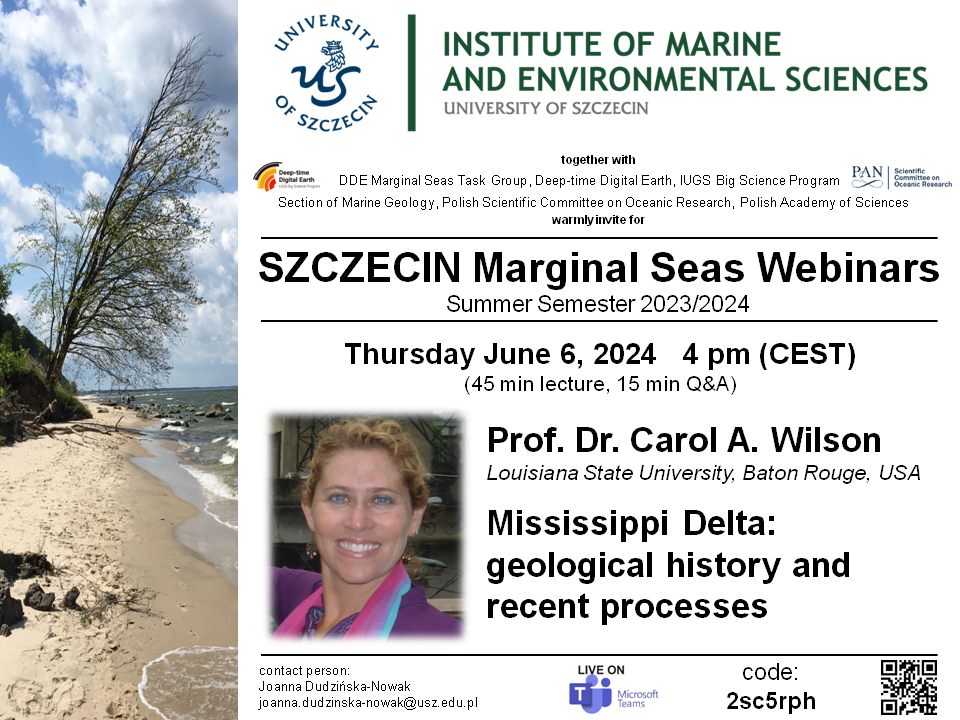
Instytut Nauk o Morzu i Środowisku oraz Sekcja Geologii Morza Komitetu Badań Morza Polskiej Akademii Nauk i DDE Marginal Seas Task Group, serdecznie zapraszają społeczność akademicką na seminarium naukowe organizowane w ramach cyklu Szczecin Marginal Seas Webinars, w najbliższy czwartek 6 czerwca 2024 r. online za pośrednictwem platformy MS Teams.
Tym razem, gościem Instytutu Nauk o Morzu i Środowisku US będzie Prof. Dr. Carol A. Wilson z Wydziału Geologii i Geofizyki Uniwersytetu Stanowego w Luizianie, USA, której badania koncentrują się na ilościowym określaniu procesów ekofizycznych kształtujących deltowe i przybrzeżne tereny podmokłe, w szczególności na interakcjach biologii, geologii i wody w celu tworzenia i utrzymywania funkcjonujących krajobrazów. W ramach seminarium prof. Carol A. Wilson wygłosi referat pt: “Mississippi Delta: geological history and recent processes”
Link do spotkania: kliknij tutaj
ID spotkania: 374 078 345 167
Kod dostępu: GyhV3X
Abstract:
“The Mississippi delta has a rich geologic and human history. During the Cretaceous, regional-scale drainage systems delivered sediments into the Gulf of Mexico that opened earlier during the Mesozoic, but large-scale drainage reorganization by the Paleocene began the conveyance of massive volumes of sediment to develop the 7th largest delta in the world. The modern Mississippi River has been building land out onto the continental shelf for the past 8,000 years, producing a landmass that covers more than 10,000 km2. When humans first colonized the region between 10,000 and 7,000 years ago, the river delta looked very different than it does today. This quintessential river-dominated delta has switched delta lobes several times due to avulsion events, resulting in a landscape that displays a myriad of prograding delta deposits, coastal wetlands maintaining elevation (marshes and swamps), and regions of retreat and land loss. How the delta developed over time–including natural and anthropogenic forcings–and its present and future condition will be presented in this talk”.