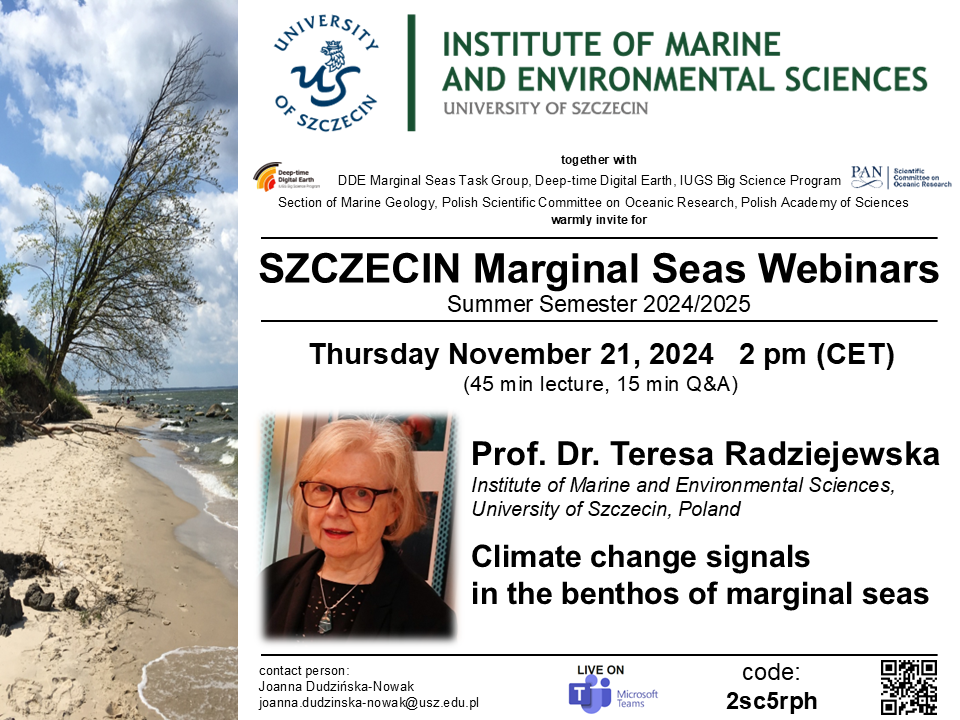
Serdecznie zapraszamy do udziału w kolejnym internetowym spotkaniu naukowym organizowanym w ramach cyklu Szczecin Marginal Seas Webinars. Wykład zatytułowany „Climate change signals in the benthos of marginal seas” zostanie przedstwiony przez dr hab. Teresę Radziejewską, prof. US z Instytutu Nauk o Morzu i Środowisku US.
Wydarzenie odbędzie się w najbliższy czwartek tj. 21 listopada 2024 r o godzinie 14:00. Prezentacja zostanie przedstawiona online za pośrednictwem platformy MS Teams.
Link do spotkania: kliknij tutaj
ID spotkania: 398 457 105 071
Hasło: vw7MD39Y
Abstract:
„The on-going climate change, primarily involving global warming and increased CO2 emissions, brings about numerous effects in marine ecosystems. The consequences of increased seawater temperature and heat content as well as increased CO2 absorption by the oceans are observed in both the abiotic and biotic spheres. In the former, effects such as ocean acidification, polar ice cover decline, changed current patterns and increased frequency of marine heat waves, have been already well documented. These and other effects translate to the biotic sphere. Marine organisms and their communities are observed to have responded to the climate change, the responses being on a scale similar to or greater than that found for terrestrial species. The responses are visible in distribution (range shifts, faster spread rates), phenology (timing of reproduction), abundance, change in the community structure (including biodiversity), calcification and demography. Marine benthic communities (i.e., communities of species associated with the seafloor) are especially suitable for long-term comparative investigations as many of the constituent species are sessile or have low mobility, are relatively long-lived and thus can integrate the effects of environmental change over time. Drawing upon ample literature documenting signals of, and responses to, the climate change in the benthos, the presentation will provide examples of effects associated with temperature change, altered hydrodynamics, ocean acidification, as well as the sea level rise and coastal squeeze.”